

Ask any South African IT leader how their AI pilot is performing, and you'll usually get one of two answers. Either an enthusiastic "it's saving us loads of time" with no numbers to back it up, or a defensive shrug because the CFO asked the same question and nobody had a good response. Both answers are symptoms of the same problem: most teams start measuring AI ROI far too late, and when they do, they measure the wrong things.
The trouble is that AI doesn't behave like a traditional IT project. When you buy a new server or a piece of licensing, the cost and the benefit are relatively easy to line up. AI is messier. Its value shows up in places your existing dashboards weren't built to watch — in the incidents that never happened, the analyst who now handles three times the workload, the customer who didn't churn because the system caught a fault before they noticed it.
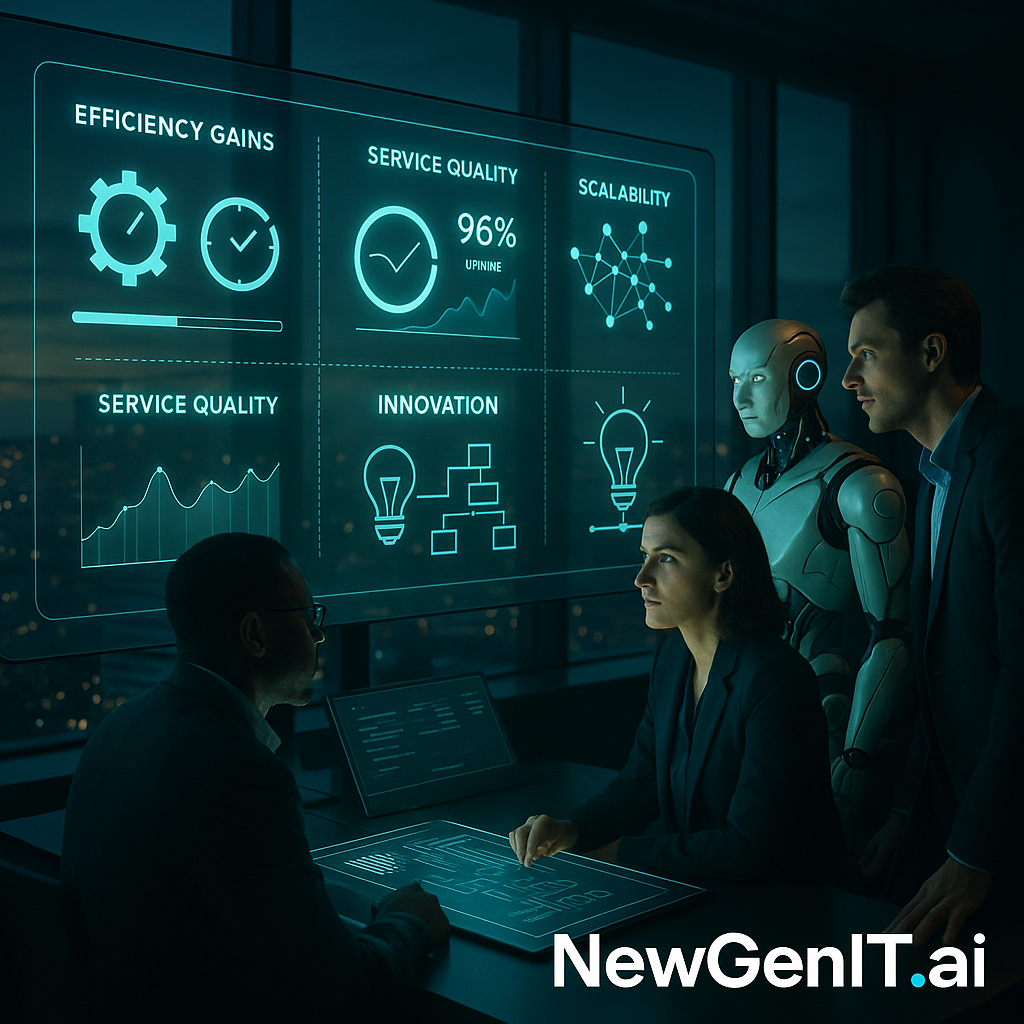
At NewGenIT, we've learned that if you don't decide what "return" means before you deploy, you'll spend months afterward trying to reverse-engineer a business case that never quite convinces anyone. So we track four categories from day one. Here's how each one works, and why it matters in a local context.
1. Operational Efficiency Gains
This is the category everyone reaches for first, and for good reason — it's the most tangible. Operational efficiency covers process automation, the reduction of manual interventions, and faster incident resolution. In practice, it answers a simple question: how much human time did AI give back to the business?
The mistake is stopping at "hours saved." That number sounds impressive in a slide deck but falls apart under scrutiny. A more useful approach is to establish a clear baseline before deployment and then track the delta over time:
- Mean time to resolution (MTTR) for common incident types, before and after AI-assisted triage.
- Percentage of tickets auto-resolved without human touch, and the accuracy of those resolutions.
- Manual intervention rate — how often a person has to step in to correct or complete an automated process.
In the South African context, efficiency gains also carry a hidden dimension: resilience during load-shedding. If your AI-driven automation lets a leaner team keep systems running through Stage 6 rotations — where a fully manned NOC would be scrambling — that's a real, quantifiable saving. We've seen clients redirect after-hours standby costs entirely because automated remediation now handles the routine failures that used to drag someone out of bed at 2am.
2. Service Quality Enhancements
Efficiency tells you how much faster and cheaper you're operating. Service quality tells you whether the business is actually better as a result. These are not the same thing, and conflating them is how teams end up celebrating cost cuts while quietly degrading the customer experience.
The metrics here focus on reliability and the end-user's lived experience:
- Uptime and availability improvements, particularly where AI enables predictive maintenance.
- Error rates across critical systems — are AI-driven checks catching mistakes before they reach production?
- Proactive vs. reactive incident ratio — how many failures were predicted and prevented versus discovered after the fact.
The proactive-to-reactive ratio is one of the most underrated numbers in AI ROI. A traditional monitoring setup tells you something has broken. A well-tuned AI layer tells you something is about to break — the disk that's trending toward capacity, the API latency creeping up before it breaches SLA, the payment gateway showing early signs of the degradation that would've triggered a flood of angry calls tomorrow morning.
The failures that never happen are the hardest to measure and the most valuable to prevent. Build the mechanism to count them from the start, or you'll never get credit for them.
3. Scalability and Flexibility
Here's where AI's strategic value diverges sharply from the cost-savings story. A traditional IT environment scales roughly linearly — double the transaction volume, and you need something close to double the infrastructure and people to handle it. AI-driven systems can break that relationship, absorbing growth without a proportional increase in cost or complexity.
This matters enormously in the rand economy. When your infrastructure costs are dollar-denominated (cloud services, most licensing) but your revenue is in rands, every point of exchange-rate volatility eats into margins. An architecture that lets you scale capability without scaling spend is a direct hedge against that pressure. We encourage clients to track:
- Cost per unit of work — is the marginal cost of each additional transaction, ticket, or user falling as volume grows?
- Time to onboard new services or workloads onto the AI-supported environment.
- Headcount elasticity — can the team handle a surge in demand without a corresponding surge in hiring?
For a growing local enterprise, this is often the difference between an expansion plan that's financially viable and one that's throttled by operational overhead. If AI lets you take on a national footprint with a provincial-sized team, that's a competitive position no spreadsheet of "hours saved" will fully capture.
4. Innovation and Competitive Advantage
The first three categories are about doing existing work better, cheaper, and at scale. This fourth one is about doing things you simply couldn't do before. It's the softest to measure and, in the long run, frequently the most important.
When AI accelerates decision-making — surfacing insights from data that used to sit untouched, or letting your team run analyses in minutes that previously took a week — it changes what your business is capable of. New products become feasible. Faster response to market shifts becomes possible. Some questions worth tracking:
- New capabilities enabled — features, services, or offerings that only exist because AI made them practical.
- Decision velocity — how much faster can the business act on data than before?
- Time freed for higher-value work — are your skilled people spending less time firefighting and more time building?
The competitive advantage dimension is especially relevant in South Africa's enterprise landscape, where being an early, competent adopter of AI still sets you apart. The firm that operationalises AI properly today is building institutional muscle its slower competitors will spend years trying to catch up on. That lead is real value, even if it never appears cleanly on a balance sheet.
A Word on POPIA and Governance
None of these four categories exists in a vacuum. In South Africa, any AI initiative touching personal data has to satisfy the Protection of Personal Information Act. This isn't a footnote to your ROI story — it's part of it. A quantified efficiency gain that quietly created a compliance exposure isn't a gain at all; it's a liability waiting to be repriced by the Information Regulator.
We fold governance into the measurement framework from day one: data lineage, auditability of AI decisions, and clear boundaries on what data the system can access. Done right, strong governance actually strengthens your ROI narrative, because it removes the risk discount that cautious stakeholders otherwise apply to anything AI-related.
Bringing It Together
The reason these four categories work is that they give stakeholders a multidimensional view instead of a single, easily-disputed number. The CFO cares about efficiency and scalability. The COO cares about service quality. The CEO and the board care about innovation and competitive positioning. Measure all four, and you can speak to every stakeholder in the language that matters to them.
A few practical takeaways to close on:
- Set your baselines before you deploy. You cannot prove improvement against a starting point you never recorded.
- Don't let cost savings be the whole story. The most durable value usually lives in quality, scalability, and innovation.
- Count the failures that never happened. Build the mechanism to track proactive prevention, or you'll undersell your biggest win.
- Treat governance as part of ROI, not a tax on it. In a POPIA world, compliance is what makes the value defensible.
- Revisit the metrics continuously. These four categories aren't just a validation exercise — they're the compass for ongoing optimisation.
Measuring AI ROI properly isn't about producing a prettier number for the next steering committee. It's about ensuring your AI investment stays honestly aligned with what the business actually needs — and being able to prove it, every quarter, to anyone who asks.
How does your team approach measuring AI ROI? We'd genuinely like to hear where it's working and where it's proving difficult — the challenges are often more instructive than the wins.